REVIEW · HO CHI MINH CITY
Saigon US Army Jeep Tours: History, Culture & Street Food
Book on Viator →Operated by Saigon Foody Tour · Bookable on Viator
A jeep tour beats the usual Saigon loop. In this private US Army jeep ride, you start at the Independence Palace, then stitch together French colonial sights, Chinese temples, war-era history, and craft workshops—plus street photo stops you’d normally need several taxis to string together. I especially like the English-speaking guide angle (names I saw come up include Luc and Khoa), because the history lands in plain language, not a lecture. And yes, the open-air driving makes the photos feel like you were part of the city’s movement.
One thing to keep in mind: timing and access can shift a bit, so don’t assume every famous stop is an inside visit. In particular, Bitexco Financial Tower is a photo/drive-by stop, and I’ve also seen reports that schedules can run late at the start or plans can swap if a major site is closed that day.
In This Review
- Key highlights you’ll actually notice
- US Army jeep touring: the fast way to get your bearings
- Independence Palace: where the story changes direction
- French colonial landmarks: Central Post Office and the French-era museum feel
- Jade Emperor Pagoda: Taoist calm in the middle of the city
- War Remnants Museum: the most direct lesson in what this city went through
- Secret Weapon Cellar and the question of how history hides in alleys
- Phuong Nam Lacquerware: where craftsmanship becomes more than a souvenir
- Cholon temple stop: Thien Hau in the Thien Hau Temple zone of daily life
- Street photo stops: Nguyen Hue, Dong Khoi, Opera House, Rex Hotel, and more
- Price and what $69 buys in real terms
- Practical tips so your 4-hour run goes smoothly
- Should you book this Saigon US Army Jeep tour?
- FAQ
- Where does the tour meet and end?
- How long is the US Army jeep tour?
- Is pickup offered?
- What’s included in the $69 per person price?
- Do I need to buy admission tickets for the stops?
- Does the tour include entering Bitexco Financial Tower?
- Is there an extra fee for non-English speaking guides?
- Is there a Lunar New Year surcharge?
- What is the cancellation policy?
Key highlights you’ll actually notice
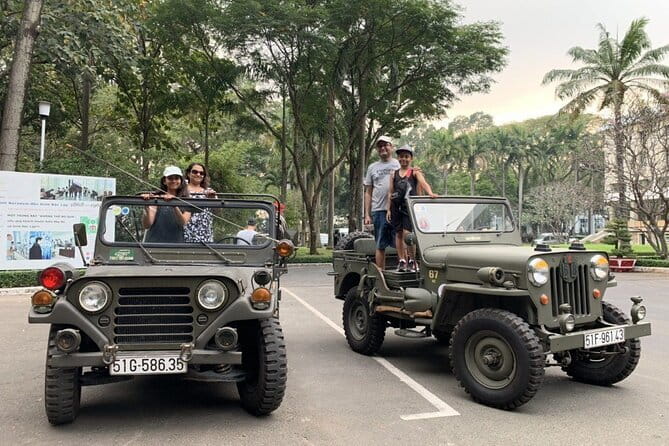
- Open-air US Army jeep driving that turns District 1 chaos into a guided route you can follow.
- Independence Palace + War Remnants Museum for big turning points in Vietnam’s 20th-century story.
- Pagoda stops with different styles: Jade Emperor (Taoist) and Thien Hau (Chinese temple tradition).
- Craft time at Phuong Nam Lacquerware where you see how finishing work becomes art.
- War-era “hidden in plain sight” history at the Secret Weapon Cellar of the Saigon Rangers.
- Street photo stops across eras, including Nguyen Hue, Dong Khoi, the Opera House area, and the Rex Hotel zone.
US Army jeep touring: the fast way to get your bearings
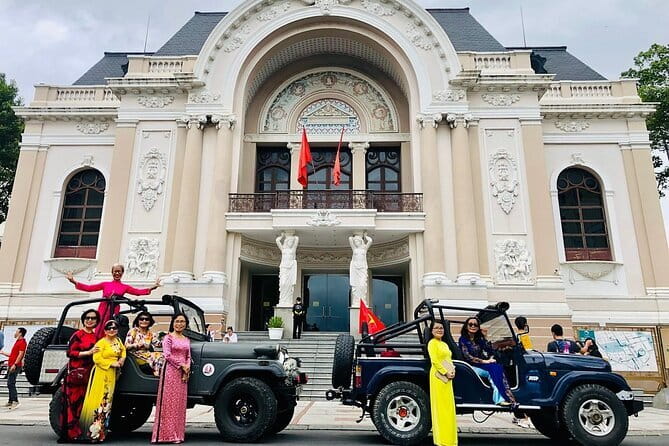
Ho Chi Minh City can feel like five cities at once: French-era architecture, war scars, Chinese community life in Cholon, and modern glass towers. This tour’s real value is that it keeps you moving through those layers in about four hours, without you having to plan every turn.
The private format helps. You’re not squeezed into a big group rhythm. When the guide points something out—like why Independence Palace matters, or what you’re actually looking at on a temple facade—you can ask follow-ups on the spot. I also like that you get cold bottled water, which sounds basic until you’re bouncing around in the heat for a few hours.
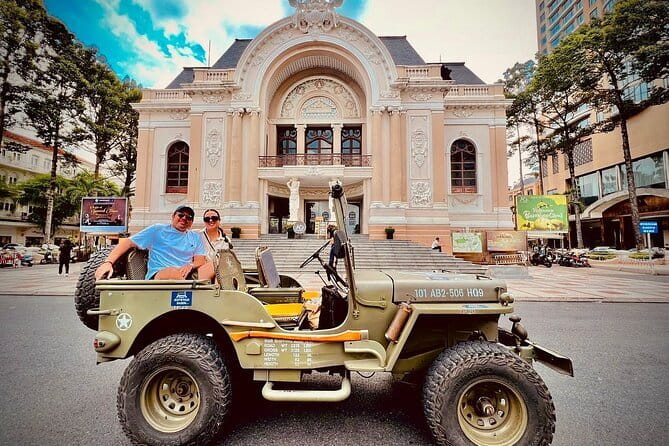
The jeep itself is the hook. Even when you’re not deep into military history, the open-air ride makes street scenes feel closer. It’s also an easier way to “see” the city’s map—where districts sit relative to each other—because you’re driving through them, not just standing in front of a single monument.
You can also read our reviews of more food & drink experiences in Ho Chi Minh City


Independence Palace: where the story changes direction

You kick off at the Independence Palace, also called the Reunification Palace. It’s one of those places where the buildings do the talking. From the outside, it’s already a strong symbol. Inside, it becomes easier to understand how dramatic political change can be—and why people remember specific rooms, layouts, and objects.
This stop is listed at about 45 minutes, with an admission ticket included. That’s enough time to walk at a steady pace, read the important areas, and not feel rushed. If you’re the kind of traveler who wants a few concrete takeaways (not a blur of names), this timing works.
One practical consideration: access can change depending on the day. I saw a report that when the palace was closed, the plan shifted to a nearby alternative (a flower-market style swap was mentioned). So if this palace is a “must,” it’s smart to keep your day flexible and expect a possible replacement.
French colonial landmarks: Central Post Office and the French-era museum feel

After the palace, the tour slows down into architecture mode. The first big hit here is the Saigon Central Post Office. This is the kind of building that makes you stop walking just to look up. It mixes French colonial and Gothic influences, and it’s easy to appreciate even if you don’t read every plaque.
You’re scheduled for about 15 minutes, and admission is included. That’s a short window—but it’s realistic in a road-and-sight tour. Think of it as a chance to orient yourself inside the space, take the classic photos, and move on while your energy still feels good.
The route also includes a stop at the Ho Chi Minh City Museum, located in a French colonial-style building. The data doesn’t give a fixed time for this one, but the structure matters: it’s a reminder that Saigon’s layers aren’t just political. They’re also administrative and cultural—shaped by how colonial cities were organized.
If you like architecture, this pair (Post Office + French-era museum building) gives you contrast right after the palace: from symbolic government power to a city designed for communications and public life.
Jade Emperor Pagoda: Taoist calm in the middle of the city

Next up is the Emperor Jade Pagoda (Chua Ngoc Hoang), built in 1909. This is a Taoist temple dedicated to the Jade Emperor, described as the King of Heaven in Chinese mythology.
You get about 20 minutes here, with admission included. That’s enough time to step in, notice the intricate details, and sit with the mood—especially if you time it when foot traffic is lighter. The biggest payoff is variety: you’re moving from French government buildings to a temple space where the purpose feels spiritual and everyday at the same time.
I like that the tour doesn’t treat this as a quick “look and leave” stop. A good guide can explain what you’re seeing—carvings, altars, and the symbolic logic of the space—so the photos feel more meaningful later.
War Remnants Museum: the most direct lesson in what this city went through
When you arrive at the War Remnants Museum, you’re stepping into the heart of Vietnam’s war memory. It was established in 1975, and the exhibits are described as a stark, compelling look at the impact of the conflict.
You’re scheduled for about 40 minutes, with admission included. That’s a practical sweet spot: long enough to take in the major themes, short enough that you don’t feel trapped in a numb loop. If you tend to read slowly, you’ll still be okay—because the exhibits here are designed for you to choose what to focus on.
This museum also changes how you’ll interpret the rest of the day. After you’ve seen what the war did, the street-level photo stops around the city don’t feel like random sightseeing—they start to feel like references. The city becomes a map of memory.
You can also read our reviews of more tours and experiences in Ho Chi Minh City




Secret Weapon Cellar and the question of how history hides in alleys

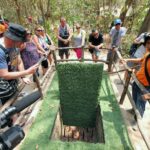
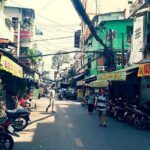
One of the most interesting stops on this kind of tour is the Hầm Vũ Khí Bí Mật Secret Weapon Cellar of the Saigon Rangers. It’s described as tucked away in a narrow alley in District 3. From the outside, it can look like any ordinary house—so the contrast is part of the point.
You get around 20 minutes here, with admission included. That time is right for absorbing what the space was used for and understanding why places like this matter. The main benefit isn’t just the objects. It’s the way it changes your instincts about the city: you start noticing what might be behind plain facades.
If you like history that feels close to real life (not just behind glass in a huge hall), this is one of the stops you’ll remember.
Phuong Nam Lacquerware: where craftsmanship becomes more than a souvenir

No Saigon tour is complete for me without at least one “how it’s made” moment. Here you visit Phuong Nam Lacquerware (Phuòng Nam Lacquerware Factory), with about 30 minutes and admission included.
Lacquerware is one of those arts where the value isn’t only in the final product. It’s in the process: layers, finishing, and the discipline required to get the surface right. The tour’s craft time helps you see that craftsmanship is labor and patience, not magic.
There’s also an emotional benefit. After museums and war sites, a craft workshop can feel like a reset—your brain shifts from heavy context to human skill. If you’re shopping, it’s also where you’ll be most confident about what you’re buying.
Tip: if you’re not into buying, you can still enjoy this stop by treating it as a visual lesson in making. Take photos of the process if allowed, and ask the guide what the key finishing steps are.
Cholon temple stop: Thien Hau in the Thien Hau Temple zone of daily life

Then the route moves into a different community feel with Ba Thien Hau Temple, also known as the Thien Hau Pagoda in Cholon (Chinatown). This one’s older than many visitors expect: built around 1760 by the Cantonese congregation, and described as one of the oldest Chinese temples in Ho Chi Minh City.
You get about 30 minutes, with admission included. Again, that’s long enough to look, read the symbols, and understand how a temple functions in a neighborhood—not just as a tourist photo point.
If you’ve had enough of museum walls for the day, this temple stop often feels like relief. If you enjoy cultural variety, it also completes the tour’s balance: French colonial, Taoist spirituality, Chinese community history, and then war memory.
Street photo stops: Nguyen Hue, Dong Khoi, Opera House, Rex Hotel, and more
The driving portion isn’t filler. It’s where you connect the dots across districts and eras. Expect photo stops along these areas, based on the planned route:
- Nguyen Hue Street: the modern heart where city life shows up fast.
- Dong Khoi Street: more historic central-area vibe.
- Saigon Opera House: built in 1897 by French architect Eugène Ferret. Even if you don’t go inside, the exterior is an anchor point.
- Rex Hotel: a legendary landmark stop for photos.
- Saigon People’s Committee building: another major government-era facade for context.
- Former U.S. Embassy site at 4 Le Duan Boulevard: you pass by the Vietnam War-era location to give the day real geographic meaning.
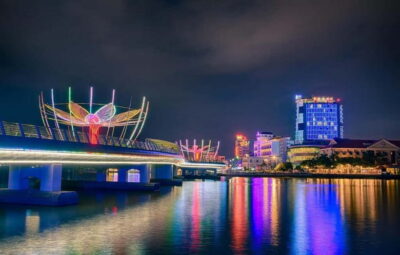
- Ba Son Bridge, also called Thu Thiem 2 Bridge, connecting District 1 with the Thu Thiem New Urban Area in District 2.
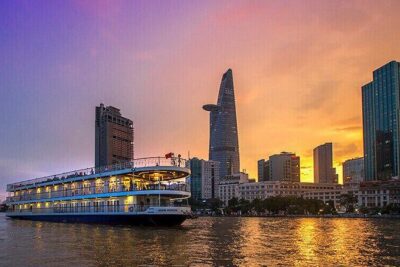
And yes, you also pass by modern skyline symbols like Bitexco Financial Tower. The key detail for planning your expectations: it’s a drive-by/photo stop, not an included entry.
If you care about photos, you’ll appreciate how these stops break up the day. You won’t just sit on museum benches. You’ll also see how Saigon looks when the city is moving around you.
Price and what $69 buys in real terms
At $69 per person for a private tour, this is competing in a category where many “city tours” either feel too short or too light on entrances. Here, the structure supports value:
- You get a private US Army jeep (your main transport).
- You get an English-speaking guide (and a specific note that a non-English speaking guide can bring a $50 USD cash surcharge).
- You get cold bottled water.
- Multiple sites show admission included in the tour plan.
So you’re not paying just for the car ride. You’re paying for the route logic—history pacing, architectural variety, and a mix of indoor and street stops that fit inside about four hours.
The trade-off is that you’re not doing one site at a super slow, deep level. This is a “get oriented fast and learn the big story beats” format. If you want 2-3 hours at only one museum, you may find this packed. If you want a single day that gives you a usable map of Saigon, the pace is the point.
Also, it’s a private activity, which means you shouldn’t need to negotiate group timing. The tour ends back at the meeting point.
Practical tips so your 4-hour run goes smoothly
Here’s how I’d prepare so nothing surprises you:
- Start point: The tour meets at Saigon Port Maritime Service Center, 5 Đ. Nguyễn Tất Thành, Phường 12, Quận 4. It also ends back there.
- Expect an open-air feel: Multiple details point to an open-air jeep experience, so plan for sun and sudden rain the way you would for outdoor sightseeing.
- Pack for multiple stops, not one: You’ll move between palaces, museums, temples, craft time, and street photo points. Wear comfortable shoes and keep your essentials easy to reach.
- Bitexco is a photo stop: If you’re hoping for an indoor visit to the tower, you’ll need to plan that separately. The tour is set up for skyline photos from the route.
- Plan flexibility helps: I’ve seen examples of day-of changes if a major attraction like the Independence Palace is closed. If that happens, don’t let it ruin the day—follow the guide’s swap plan.
If you want the smoothest experience, communicate your preferences before you roll: history focus vs. photo time, and whether you want the guide to spend extra explanation at the museum or temple stops.
Should you book this Saigon US Army Jeep tour?
Book it if you want a one-day overview of Ho Chi Minh City that connects history and architecture with real street visuals—without spending your whole trip stuck in traffic or hunting tickets. This is especially good for couples, first-timers, and anyone who likes seeing multiple districts in a single outing.
Skip it or adjust your expectations if your top priority is entering every landmark building. Bitexco is photo/drive-by, and the tour’s format spreads time across several stops. Also, pay attention to language preferences: if you strongly want an English-speaking guide, the tour notes a possible $50 USD cash surcharge for non-English speaking guides.
If you go in with the right mindset—short, guided stops; lots of context; and a memorable open-air ride—you’ll get your money’s worth.
FAQ
Where does the tour meet and end?
It starts at Saigon Port Maritime Service Center, 5 Đ. Nguyễn Tất Thành, Phường 12, Quận 4, Ho Chi Minh City, and it ends back at the meeting point.
How long is the US Army jeep tour?
The tour runs for about 4 hours (approximately).
Is pickup offered?
Yes, pickup is offered.
What’s included in the $69 per person price?
The price includes a private American US Army jeep, a professional English-speaking guide, cold bottled water, and entrance fees where applicable in the included stops.
Do I need to buy admission tickets for the stops?
Entrance fees are included for the tour’s listed stops that specify admission included (for example Independence Palace, Saigon Central Post Office, Emperor Jade Pagoda, War Remnants Museum, Phuong Nam Lacquerware, Secret Weapon Cellar, and Ba Thien Hau Temple).
Does the tour include entering Bitexco Financial Tower?
No. Bitexco Financial Tower is handled as a drive-by/photo stop rather than an included entry.
Is there an extra fee for non-English speaking guides?
Yes. There is a $50 USD cash surcharge for non-English speaking guides.
Is there a Lunar New Year surcharge?
Yes. A 35% extra charge applies for the whole Lunar New Year period described as starting from the last day of the old Lunar Year until the 4th Jan of Lunar New Year.
What is the cancellation policy?
You can cancel up to 24 hours in advance for a full refund. If you cancel less than 24 hours before the start time, the amount you paid is not refunded.